Thursday, July 21, 2016

The Myth of the Wealthy, Best-Selling Author


When best-selling author Jackie Collins died last September, I went into a depression. Not so much because of the loss  of such a great talent - although I'm not ashamed to admit I've read and enjoyed some of Collins' so-called "trashy" books.
 
What depressed me was reading in Collins' final interview in People Magazine that her juicy novel "Hollywood Wives" sold 15 million copies. As is human nature, I couldn't help comparing my own work to Collins' amazing sales record.

I doubt if the sales of my novel, "The Chloe Chronicles," and the nonfiction book I co-wrote with Raymond Lambert, "All Jokes Aside: Comedy Is a Phunny Business," come anywhere close.

As the saying goes, comparison is the thief of joy and confidence.

Several months after Collins' death, just this past June, I came across a much more relatable writer. Author Neal Gabler's fascinating and eye-opening article, "The Secret Shame of Many Middle-Class Americans," in The Atlantic exposes the truth of many working writers.
 
Looking at Gabler's list of accomplishments, it would seem that he's "made it" and is living the American dream. He's won critical raves for his books, including a well-received biography of Barbra Streisand, written for television, holds a master's degree, has taught at prestigious colleges, and even had one of his works optioned by Oscar-winning filmmaker Martin Scorsese. 
 
But as Gabler reveals in The Atlantic article, he and his wife often struggle financially. He admits that like millions of Americans, there have been many times when he couldn't afford a $400 emergency without borrowing. 
 
Comparing Gabler and Collins is a study in contrasts. Collins lived a lavish life in Beverly Hills, while Gabler lives thriftily on the opposite coast in the Hamptons. As Gabler describes in his article, though the Hamptons have an image as the playground for the rich and famous, his modest house is situated where the "poor people" live year-round, unlike the vacation homes of the wealthy jet-set crowd.

Collins and Gabler represent two very different realities: Collins was like a character in one of her far-fetched plots, living in high style and rubbing shoulders with the Hollywood elite, while Gabler's humble lifestyle reflects the everyday life of many working folks, including us writers.

Reading about another accomplished writer also helped me put things into perspective. Earlier this year I read "The Last Interview and Other Conversations: Philip K. Dick," which contains a collection of interviews with the late science fiction writer. Since his death in 1982 at the age of 53, Dick has gained respect as a visionary writer whose novel "Do Androids Dream of Electric Sheep?" was the basis for the classic sci-if flick "Blade Runner."

During his lifetime, however, Dick struggled to make ends meet. In one interview, he related that once when he was shopping for groceries, he found himself envying the cashier, who probably made more money than him.

Many of us writers have dreams of penning a bestseller - or, like Collins, penning multiple bestsellers and living a fabulous life in which our works rake in huge advances from mainstream publishers and a steady stream of royalties that enable us to quit our day jobs. In this fantasy, we can leave our financial concerns to a phalanx of accountants and business managers. And like Collins, we can live in a glamorous place like Beverly Hills, rolling out of bed each morning in our sprawling manses and retreating to our well-appointed home office to spend a few hours cranking out our next bestseller.

But for many of us writers, our realities are more like Gabler and Dick. We remain committed to telling our storiesm, but we must live within in our means and rely on incoming generated by day jobs, moonlighting gigs and/or supportive spouses and extended family who take up the slack while we pursue our dreams.

Is the struggle worth it? If you're someone for whom storytelling is a passion, then the answer is a resounding yes.

Gabler summed it up eloquently in his article: "I chose to become a writer, which is a financially perilous profession. ... I chose to write long books that required years of work, even though my advances would be stretched to the breaking point and, it turned out, beyond. We all make those sorts of choices. ... These are the choices that define who we are. We don't make them with our financial well-being in mind, though maybe we should. We make them with our lives in mind. The alternative is to be another person."

Friday, July 15, 2016

Memories of the Drexel

The Drexel Theatre, my hometown arthouse theater that showcases independent movies from around the world, reopens today after a $1.5 million renovation. 

I recently got a behind-the-scenes tour of the "new and improved" facility as part of an article I wrote for the current edition of the Bexley News. One of the coolest parts of the tour was seeing the projection room, where the magic of the moviegoing experience begins.
The projection room at the Drexel Theatre.
 
The Drexel is within walking distance of where I grew up in Columbus, Ohio, so I always thought of it as one of several neighborhood movie theaters that were going strong when I came of age in the '80s (long before the advent of the multiplex). One of my fondest memories of the Drexel is that it's the landmark where I was first exposed to independent cinema. As an eighth grader at Holy Spirit School, I snuck into an R-rated movie at the art deco picture palace.

I was otherwise a very well-behaved and obedient child, but one afternoon in 1985, I decided that instead of going straight home from school like I was supposed to, I'd head to the Drexel and check out what was playing. Like the rebellious character Gigi in my novel "The Chloe Chronicles," I bought a ticket to a tame PG-rated movie and proceeded to duck into a much more interesting R-rated feature instead.

I'm not sure why the comedy/drama "The Coca-Cola Kid" appealed to my 13-year-old sensibilities. Maybe because it was 1985 and "New Coke" had just come out and was all the rage.

Sitting in the darkened theater in my Catholic schoolboy uniform, I felt very sophisticated watching this sexy foreign film, which starred Aussie actress Greta Scacchi and American actor Eric Roberts (who rose to fame before his little sister, Julia; perhaps you've heard of her). 

"The Coca-Cola Kid" was the first indie movie that I bought a ticket to with my own money. Even as a sheltered middle-school kid, I could tell there was something different about this movie. It wasn't as formulaic and predictable as the mainstream movies that I voraciously consumed on cable TV in my grandparents' rec room.

Other fond memories of the Drexel:

Meeting actor Joe Morton. I don't remember the occasion that brought Morton to the Drexel, but interviewing him was one of my first assignments for the Call and Post Newspaper in the early '90s. The revered African-American actor is now famous for his role as Olivia Pope's father on "Scandal," but I knew him from the John Sayles indie classic "The Brother from Another Planet." Morton was easy to talk to, especially for the very shy, very green "cub reporter" that I was.

Meeting actor Leon Robinson. Another accomplished black actor, Robinson was in town to promote the movie "Once Upon a Time When We Were Colored." He was also easy to talk to when I interviewed him. I mentioned to him that I grew up watching him as the black saint who comes to life in Madonna's iconic "Like a Prayer" video. When I asked him what it was like working with the Material Girl, he said, "She's totally cool."

Supporting black cinema. Some of the best movies made by and starring African Americans, I've seen at the Drexel. These vehicles made outside the Hollywood mainstream defy stereotypes and present African Americans as three-dimensional human beings, including "Down in the Delta," "Daughters of the Dust," "To Sleep with Anger" and the above-mentioned "Once Upon a Time When We Were Colored," co-starring Robinson and Columbus native Al Freeman Jr.

Family outings. Seeing Robert Duvall's Christian drama "The Apostle" with my grandparents and my grandmother's sister, my Aunt Rudene, was a reel treat (pun intended). Bob and Pearl Bourne (the reason why their last name doesn't have an "A" on the end like mine is a long story) and Rudene Goolsby were never big moviegoers, so seeing a church-related film that we all could enjoy was one of the best moviegoing experiences of my entire life and one of my favorite memories of all time.


Wednesday, July 13, 2016

Is It Ever Okay To Go About Business As Usual After A Tragedy?

The nation is still reeling from the deaths of Alton Sterling and Philando Castile and the murder of five police officers and bystanders during a protest march in Dallas last week.

The racial and social-justice issues associated with these events affects all of us. As President Obama said, "This is not just a black issue. This is not just a Hispanic issue. This is an American issue that we all should care about."

But I would add that as an African American, and particularly as an African American who works in media, I feel particularly touched by these issues. I also feel a responsibility to comment on these issues on social media, to not just go about business as usual when tragedies like these occur.

And, unfortunately, tragedies like these are occurring with disturbing frequency.

As a writer and filmmaker, I depend on social media as an invaluable tool to raise awareness of my work. But, as many of us know, social media has its downsides.

When I awoke the morning of July 8, I was about to post my latest blog entry about the writing life. But when I turned on my computer and found out about the shootings in Dallas, I realized it would be inappropriate to "link-drop" my blog when so much pain and turmoil was going on in the world. 

At the least, self-promotion at a time like that would come across as being indifferent to such horrific incidents; at worst, insensitive.

Artists like myself who hold down day jobs are in a precarious position. On the one hand, you want to be "woke" - socially conscious, informed and engaged. On the other hand, my current and future employment often causes me to feel that I must walk on eggshells in fear that something I post could be misconstrued as offensive.

And it's so easy to offend these days.

I sometimes pre-schedule social media posts. While it may be convenient to write up tweets, Facebook comments and other social media posts in advance, you also run the risk of your pre-scheduled posts going out after a major tragedy has occurred overnight, making you look clueless and tasteless, as if you're like the infamous Emperor Nero, casually playing the fiddle as Rome burns.

What should be the guideline for when and when not to comment on a tragedy? When is it okay to go about business as usual without seeming as if you're uncaring?

In addition to the Dallas shootings, the deaths of Sterling and Castile and the Orlando nightclub tragedy last month, should I have also commented on the attacks at the Istanbul airport and in Baghdad? Does geographical and/or cultural distance from an event give you a free pass to ignore it? Of course not, but where do you draw the line?

These aren't easy questions and there are certainly no easy answers.

Thursday, June 23, 2016

My Columbus Homecoming Was No 'Joke'

Me and Fort Hayes Principal Dr. Milton Ruffin on the
Ohio Theatre stage as the Fort Hayes graduation
concluded on June 4 (Photo By Terry Anderson).
Being recognized as an alumnus at Fort Hayes Metropolitan Education Center's graduation ceremony on June 4 at the Ohio Theatre in my hometown of Columbus was the culmination of a busy month of activities related to the new book "All Jokes Aside: Comedy Is a Phunny Business."

The book, which I co-wrote with Raymond Lambert, tells Raymond's story, from humble beginnings as the son of teenage parents,  to working in high finance for Chris Gardner (whose life was the subject of the blockbuster movie "The Pursuit of Happyness" starring Will Smith), to opening the legendary Chicago comedy club All Jokes Aside.

I have to give a huge shout-out to Raymond's Morehouse classmate, Eficioando President and CEO Eric J. Troy, who organized the "All Jokes Aside" promotional events in my hometown. 

In just over a month, Eric pulled together of an amazing series of events, including author talks and book signings at the Funny Bone comedy club and the Barnes and Noble bookstore at the Easton Town Center. He also arranged great press coverage - one of the most effective ways to boost book sales. I'll be forever indebted to Eric - he did everything but hire a pilot to write my name in the sky!
 

The events began on May 10 with a pizza lunch at the Funny Bone with a group of about 20 students from Mifflin High School. Mifflin is in close proximity to the Easton Town Center, where the Funny Bone is located. The Mifflin students asked insightful questions about writing and life, in general.

Me (crouching, center) with Mifflin High School students at the Funny Bone.
Also pictured: Steiner Director of Community Affairs Ben Tyson (crouching, left)
and Eficionado President and CEO Eric J. Troy.
The evening of May 10 was our big debut at the Funny Bone. Emmy-winning WBNS-10TV anchor Jerry Revish led a question-and-answer session with Raymond and I.


Dr. August Parker III, left, Eric J. Troy, me, Raymond Lambert,
Greater Columbus Arts Council CEO Tom Katzmeyer,
WBNS-10TV anchor Jerry Revish and Matt Habash, president
of the Mid-Ohio Foodbank and former Columbus City Councilman. (Photo By Shellee Fisher) 

Before the Q & A, the evening kicked off with remarks by Dr. Augustus Parker III, who sponsored the event with Eficionado; Gahanna Mayor Tom Kneeland; and Greater Columbus Arts Council President Tom Katzenmeyer. Columbus City Councilman Shannon Hardin presented Raymond and I with resolutions recognizing our contributions - glad my mom and dad were there to see that!


Eficionado President and CEO Eric J. Troy, left, me holding
the Columbus City Council resolution and Columbus City
Councilman Shannon Hardin. (Photo By Shellee Fisher)
The next day, on May 11, Raymond and I spoke to students at my alma mater, Fort Hayes Metropolitan Education Center. Once again, we spoke to a group of about 20 students who have expressed an interest in creative writing. And, once more, I was bowled over by the students' insightful questions and willingness to open up and engage in a dialogue.
One of the many highlights of the Fort Hayes visit was being recognized as an alumnus by Columbus City Schools Superintendent Dr. Dan Good and Fort Hayes Principal Milton Ruffin.


Raymond and I (center, standing) with the Fort Hayes students.


That evening, the "All Jokes" events culminated with the Barnes and Noble Easton Town Center appearance. Raymond and I discussed the book with an intimate group of family, friends and a few bookstore patrons who gathered to hear us talk and have their books signed. Being featured at a major bookstore like Barnes and Noble was a dream come true.
Raymond and I at our author talk at the  Barnes and
Noble bookstore at the Easton Town Center
.

One really cool thing that happened was that after I posted my photo next to the Barnes and Noble poster on social  media and commented that it was cool sharing a bookstore poster with best-selling author David Baldacci, Mr. Baldacci was kind enough to return the favor! As it turns out, Baldacci, like Raymond, is an alumnus of the University of Virginia. Small world!
Best-selling author David Baldacci tweeted
a photo of him standing next to the poster
featuring me and co-author Raymond Lambert.
On May 27, I returned to Fort Hayes to speak to another group of students who missed the May 11 session. A week later, I joined the members of the Class of 2016 for graduation, placing cords around the graduates' necks as they walked across the stage of the Ohio Theatre. 

I was impressed by the wide array of talent that the Fort Hayes students showcased at the graduation. The ceremony included music and dance performances. In addition to displaying world-class talent, these young people are gifted at expressing themselves in front of an audience - much more so than I was at their age!

I was born and raised in Columbus, and I've always appreciated my hometown as a place where the arts flourish.


Friday, June 17, 2016

The Challenges Of Collaborating Long Distance

During a recent visit to my high school alma mater, Fort Hayes Metropolitan Education Center in Columbus, Ohio, my "All Jokes Aside" co-author, Raymond Lambert, and I spoke with a group of students who have expressed an interest in the arts.

The students asked insightful questions. One young lady's question, in particular, stood out: What was the biggest challenge of writing the book?

"This is going to sound silly," I said, "but actually the biggest challenge, from my perspective, was the time difference between Columbus and Chicago, where Raymond lives. As you know, Columbus is on Eastern Time and Chicago is on Central Time and they're an hour behind us.

"If Raymond and I had an appointment to talk at 1 p.m. on a Sunday, for example, I always had to figure out if I was supposed to call him at noon or 2 p.m. I've always been terrible at math and I often had to 'Google' to confirm what time it was in Chicago."

My co-author Raymond Lambert and I working in
a Chicago coffee shop on one of the weekends
that I commuted to Chicago.

My exchange with this student emphasizes an important point: there are pros and cons to writers - or any type of artist, for that matter - collaborating long-distance on a project.

On the one hand, if an inspiration came to me out of the blue early in the morning, I couldn't just pick up the phone and call Raymond because I knew it was too early in Chicago and I didn't want to jar him out of a sound sleep.

On the other hand, not immediately being able to reach your writing partner forces you to plan out and prioritize what's most important to discuss. And, heaven forbid, if the two of you ever disagree on something, the distance creates an automatic cooling-off period. You can't just jump in your car and give someone a piece of your mind off without enduring a long, tedious road trip.

I remember as a teen watching BET's "Video Soul" music show and learning that the 1986 chart-topping duet "On My Own" with Patti LaBelle and Michael McDonald was recorded by the singers in two separate studios on opposite coasts. The split-screen music video reflects the separation and actually makes sense since it's a breakup song.

At the time, I remember thinking how strange it was that two artists could produce such a heartfelt and soulful piece of work without even having been in the same room.

But having completed the book project with my buddy Raymond, I now know that two or more creative people who happen to be in different places can, indeed, seamlessly blended voices and ideas.

Tuesday, June 7, 2016

Remembering Prince On His Birthday

Today would have been Prince's 58th birthday. Like millions of fans around the world who continue to mourn The Purple One's untimely death, I'm reflecting on everything he meant to me.

I'm literally a lifelong Prince fan. I was 11 going on 12 in the summer of '84 when my Aunt Cathy took me and my cousins Darlene and Stacy to see "Purple Rain." From the moment that the opening scene of The Revolution performing "Let's Go Crazy" came onscreen, I was an instant convert.


It's ironic that Prince - a clean-living vegan who shunned all recreational drugs - reportedly died of an overdose of opioid medication that was originally prescribed for hip injuries. To paraphrase one Rolling Stone reporter: Prince personified complexity and contradiction. 

There are numerous anti-drug messages in Prince's music that made young people like me who grew up idolizing him adopt drug-free lifestyles:

"What you puttin' in your nose?/Is that where all your money goes/The river of addiction flows," Prince sings in a chastising tone in "Pop Life" from the '85 "Around the World in a Day" album.

At the beginning of '88's "Lovesexy" album he declares, "The reason why my voice is so clear is because there's no smack in my brain."

Prince's alleged addiction to prescription painkillers doesn't make me think any less of him. We all have compulsive behaviors and habits we can't seem to shake.

The older I get, the more I realize that my heroes aren't superhuman. But Prince seemed like the closest thing to it: energetic, slim and fit, and rocking a full head of hair - not a fleck of gray - up until the day he died.

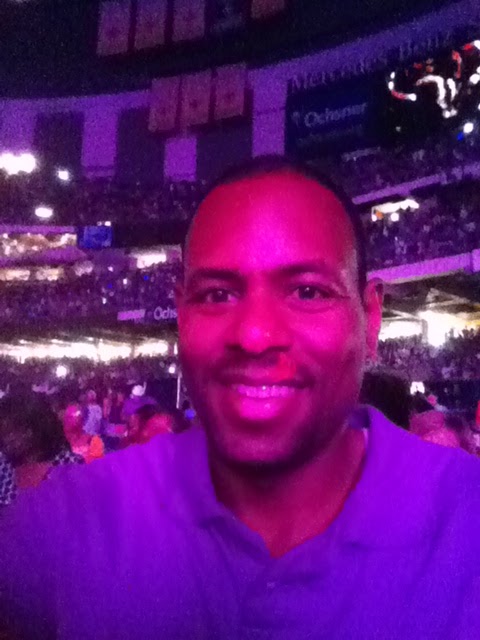
I was privileged to see Prince perform many times. The last time I saw him was in July 2014 at the Essence Festival in New Orleans to mark the 30th anniversary of "Purple Rain." Even then, he was a seemingly inexhaustible spark plug of funk. He wasn't doing the splits or jumping off pianos anymore, but he still played a mean guitar and worked the stage with the youthful exuberance of a teenager.
A selfie I took in the New Orleans Superdome
during Prince's July 2014 concert.

I'm hoping that Prince's abrupt death will spark not only a dialogue, but some kind of legislative action about the need for better alternatives for those dealing with chronic pain. In the meantime, we'll continue to jam to his music and party like it's 1999.

It's a cliché, but Prince's music has truly been the soundtrack of my life. There are so many things in my life
and work that Prince has influenced. As Questlove said in a moving tribute, I modeled my entire life after Prince.

When I was preparing to release my debut novel "The Chloe Chronicles" and found model Veronica Seitz to pose for the cover, I mused that Veronica is like a "Prince girl": an exotically beautiful woman whom Prince would groom for stardom, hand a microphone and place onstage in a lacy outfit. 
"Chloe" cover girl Veronica Seitz.


And I've buried Prince-inspired "Easter eggs" (hidden messages) in several of my other works. In the final scene of my play, "The Springtime of Our Lives," when the Bennett family is about to attend Easter Sunday church service, the character Denise comments on the beautiful weather: "Springtime's always been my favorite time of year."

That line is taken directly from Prince's haunting ballad "Sometimes It Snows In April" from the '86 "Parade" album.

There were several occasions when I almost met Prince. In the summer of 2002, I attended a fan gathering at his Paisley Park compound in Minneapolis. After a typically mind-blowing jam session that extended into the wee hours of the morning, Prince announced from the stage that the entire audience was invited to join him to see the Tom Cruise movie "Minority Report" at a local movie theater.

I figured this was one of Prince's infamous practical jokes and instead went back to my hotel room to crash. But the news later reported that Prince did, indeed, treat 200 people to see the movie and bought everyone popcorn, candy and soda pop.

On another occasion in the early 2000s, I was standing in line outside Paisley Park, waiting to get in to see the Minneapolis Mozart perform. I looked up to see a shadowy figure that resembled the mysterious Mr. Nelson overlooking the crowd from a second-story window. Prince noticed me spying him in a private moment and turned and walked away.

On yet another occasion, Prince came to perform in my hometown of Columbus, Ohio, in 1998. As was his wont, he invited the audience to an after-party at a nightclub. I happened to be standing near the backstage area at the now-defunct downtown nightclub Mecca as Prince approached the stage. I smiled at him and he smiled back.

And there was the time in March 2005  when I was covering the NAACP Image Awards in Los Angeles for the Call and Post Newspaper. I was in line to pick up my press pass when I noticed a short man dressed in a mustard-colored suit getting out of a limo - none other than His Royal Badness!

As Prince sauntered by me in his trademark heels, we made eye contact. I could have offered my hand and simply said, "Hi. My name's Chris and I'm a huge fan." But I was too shy and afraid one of his bodyguards would have had me thrown out for approaching the notoriously enigmatic star.

Although I didn't get an opportunity to meet Prince, I've been blessed to meet people who knew him well, including Sheila E., Wendy and Lisa and Revolution band mates Brown Mark, Matt Fink and Bobby Rivkin, and "Purple Rain" co-stars Apollonia Kotero and Jill Jones (who has a great new dance album titled "I Am").


The Purpose Magazine cover story I wrote on Denise "Vanity" Matthews.

I also interviewed Vanity 6 lead singer Denise Matthews (aka Vanity), who passed away in February, not long before Prince, her former boyfriend. I wrote a cover story on Denise's transformation from "vamp" to Christian evangelist in Purpose Magazine. When speaking with Prince's ex, I reverted to a middle-school fanboy, later boasting to friends and family that Vanity called me at home!


Me, Sheila E. and her dad Pete Escovedo at the Conga Room nightclub
 in L.A. in March 2002.
All of Prince's "subjects" whom I've had the pleasure of interacting with have been warm, friendly and accessible. I'd like to think Prince would have been the same if I'd had the chance to know him. 

Since Prince's death, radio stations and music lovers all over the world have been rediscovering his classic hits. But as for me and other lifelong fans, we've never stopped playing his music.

Hardly a day has gone by since that fateful summer of 1984 when I first saw "Purple Rain" that I haven't played a song Prince wrote and produced for himself or someone else.

This past Sunday, June 5, realizing Prince's birthday was coming up, I decided to start listening to all of his 39 albums in sequential order, starting with his 1978 debut, "For You." So far, I'm up to 1980's "Dirty Mind."

What is my favorite Prince album? I'd have to say "Lovesexy." Maybe it's because the theatrical "Lovesexy" tour was the first time I saw him live, journeying to Cincinnati's Riverfront Coliseum with my high school friend Michele Burr (whom I'm happy to call a close friend to this day).

The song "Anna Stesia" from "Lovesexy" is one of my all-time favorite Prince songs. The lyrics of the dramatic ballad depict Prince's lifelong struggle to reconcile his sexuality and his spirituality. The song also documents his brave decision to take the road less traveled and follow his heart in a fickle industry where you're only as good as your last hit.

These lyrics from "Anna Stesia" represent what Prince's genius means to me: "Music late/nothing great/no way to differentiate/I took a chance..."

Prince was a once-in-a-lifetime artist and human being who will never be forgotten. One of his favorite sayings - written in that unique symbol language that he adopted long before texting was invented - was "May u live 2 see the dawn." 

For myself and the millions of others who will continue to adore and treasure him, the dawn has broken. Prince's spirit, his music and his legacy will live on.


Thursday, June 2, 2016

Come To Paisha's Place

I'm so proud of my friend and "dream-releasing buddy" Paisha Thomas. She just released her debut CD, "Paisha," and will be performing selections from the album during the  "Cover Me Session Two: Come Together" concert on Friday, June 3, at 7 p.m. at 300 E. Long St. in my hometown of Columbus, Ohio.
 
Paisha helped me realize a dream I've had since I became a music fan as a preteen: having my name listed in the liner notes of an album. I'm credited as a co-writer of the song "Love Don't Stand a Chance (Big Mama's Song)" on Paisha's album - a true honor.  

Paisha played the leading role of "Big Mama" in "The Springtime of Our Lives," a play I wrote, produced and directed in 2013.

There's a scene in which Big Mama, her granddaughter Myra (played by the phenomenally talented Sufiy James) and teenage granddaughter-in-law Denise (played by Paisha's amazingly talented daughter, Christian Cooper) clean house while Big Mama belts out a gospel-flavored number. When I was writing the scene, I envisioned The Pointer Sisters' "Neutron Dance" - venting frustration about all the chaos going in the world.


Me (center, front row) and Paisha Thomas (center, back row) with
"The Springtime of Our Lives" cast, clockwise from left: Nancy Niki Penn,
Helen Price-Outlaw, Sufiy James, Keith "Speak" Williams,
Christian Cooper, Jerry Weekly and David Holland.
I jotted down a few lyrics, including a phrase that kept rattling around in my head for some odd reason: "They keep raising the price of stamps." I gave the lyrics to Paisha and Brian Szuch, who co-produced Paisha's album and played in the "Springtime" band when we put on shows in Columbus in October 2013 and March 2014 and Cleveland in June 2014. 

I was amazed when, in a very short amount of time, Paisha and Brian took my scribblings and fleshed them out into a full-length song that really captures Big Mama's world-weary mood yet steadfast faith that God will work everything out.


"Love Don't Stand a Chance (Big Mama's Song)" is just one of the gems on Paisha's album. I love all of the 13 tracks, and here's a look at a few of the highlights:

"Courage" is an upbeat song about exercising the inner strength to leave a situation that's holding you back and realize your full potential. I heard an early version of this song that Paisha recorded a few years ago during one of her band rehearsals, and it's always been one of my favorites. 

"Water Wash" is a moving ballad about the strength of the human spirit to survive unimaginable hardships. The song was inspired by Lupita Nyong'o's Oscar-winning performance in "12 Years a Slave," which Paisha and I saw together.

"Seventeen Suns" is a mellow tune that reminds me of strolling along in the park, enjoying the sunshine and the beauty of nature. 

"Inside Out" is a powerful exploration about all the good things that can result when you have the fortitude to take a look inside and discover your true self and go after what you really want in life.

Each of the songs showcases Paisha's rich, soulful voice. Her music is a unique fusion of R&B, rock, folk and her gospel roots. Like another of my favorite artists - the late, great Prince - Paisha Thomas is an artist who defies categorization in the best way possible.

Paisha will be selling the album at the "Cover Me Session Two: Come Together" concert on June 3. The show will feature Paisha and a variety of awesome Columbus singers and musicians raising money for art and music education for public school students. For tickets and more information, visit Eventbrite by clicking this link.