Wednesday, March 2, 2016

Washington, D.C., Was A Liberating Experience

I had a great time during my March 1-2 trip to Washington, D.C., to help promote "All Jokes Aside," the new book I co-wrote with Raymond Lambert.

All Jokes Aside tells Raymond's inspirational story: from his working-class upbringing by teen parents in Wilmington, Del., to becoming a successful investment banker who once worked for world-famous businessman Chris Gardner (whose life was the subject of the blockbuster movie "The Pursuit of Happyness" starring Will Smith) to opening the legendary Chicago comedy club All Jokes Aside. 

The club helped launch the careers of many of the Kings and Queens of Comedy, including Oscars host Chris Rock, Oscar winner Mo'Nique, Steve Harvey, Cedric the Entertainer, Carlos Mencia, D.L. Hughley and the late, great Bernie Mac, just to name a few.


The D.C. experience began with a March 1 reception at the law firm Reed Smith. Many of Raymond's friends, family and supporters turned out to wish him well and get their books signed. Raymond's appearance in D.C. was one of those "full circle" experiences because in the '90s when All Jokes Aside was at the peak of its popularity, he tried to open another location of the club in D.C.

One of the highlights of the Reed Smith reception for me was meeting Raymond's younger brother, Nevan, and his lovely wife and two children. I'd heard much about Nevan from Raymond's childhood stories when we were writing the book, and I told Nevan that I'll be interested to hear his feedback on the "All Jokes Aside" book. As is often the case, people who grew up in the same house have different memories and different perspectives on the same events.

The D.C. experience culminated with a March 2 discussion and book signing at Busboys & Poets, a really cool bookstore/restaurant/performance space that has several locations in the nation's capital. The "All Jokes Aside" engagement took place at the store's bustling 14th Street location.


My original purpose in attending the Busboys & Poets event was just to be there for moral support. Raymond was supposed to take part in an onstage discussion about the book with comedian Tony Woods for the bookstore's "Politics and Prose" dialogue series. 

As fate would have it, Tony ended up running late because of a miscommunication and Raymond asked me to step in to "pinch-hit" and interview him. I agreed with Raymond that this arrangement made perfect sense since I'm a journalist who interviews folks all the time and the conversation would flow naturally since we spent so many months collaborating on the book.

That's not to say I wasn't a bit nervous, since public speaking can be a bit intimidating in any setting. But the supportive crowd of about 40 or so people who turned out to Busboys & Poets seemed engaged as Raymond and I discussed the process of writing the book and some of the major beats of his story. 


My conversation with Raymond took place in Busboys & Poets' cool performance space, in which an intimate stage faces the audience as they sit at candlelit tables munching on food and sipping drinks from the venue's excellent restaurant. Not only was it cool to be able to promote "All Jokes Aside" in a big-city bookstore, it was inspiring to be in a bookstore that is obviously thriving, with every table and chair full on an average weeknight.


After my discussion with Raymond concluded, the stage was converted for the venue's open-mic night, which was also filled to capacity. It's so heartening to see a successful bookstore in this day and age when there are so many reports that bricks-and-mortar outlets are supposedly dying, and that books and other printed publications are becoming extinct in this digital age.

D.C. was a liberating experience (pardon the pun) and I look forward to participating in future "All Jokes Aside" events and helping to get the word out about Raymond's motivational story.

For more information and to order a copy, visit the "All Jokes Aside" page on Amazon.com.


Wednesday, January 20, 2016

All Jokes Book Officially Released

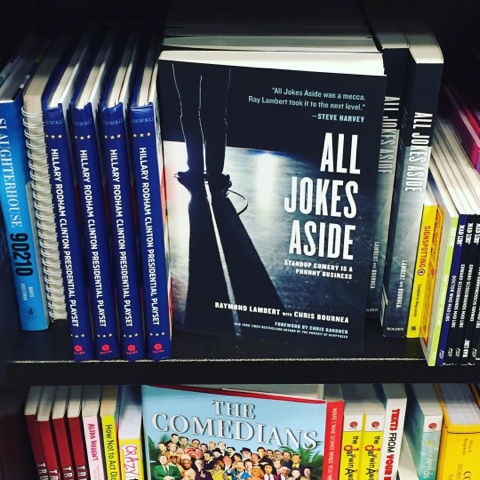
I'm excited to announce the official release for the new book "All Jokes Aside: Standup Comedy Is a Phunny Business," which I co-authored with Raymond Lambert. "All Jokes Aside" is available in bookstores and online at Amazon.com from Agate Bolden publishers. To buy your copy and for more information, click this link.
 
The new "All Jokes Aside" book on display
in a Barnes & Noble store in Chicago.

"All Jokes Aside" chronicles Raymond's amazing life story, co-founding the famous Chicago comedy club of the same name that launched the careers of comedy superstars such as Chris Rock (who'll be hosting the Oscars next month), Oscar winner Mo'Nique, Dave Chappelle, Steve Harvey and Carlos Mencia, just to name a few.

In the book, Raymond relates how he rose from a working-class upbringing as the son of alcoholic teen parents, embarked on an exciting career as a Wall Street stock broker and eventually made his way to the Windy City to work for Chris Gardner.

Yes, that Chris Gardner, the internationally renowned African-American businessman whose life story was the basis of the blockbuster movie "The Pursuit of Happyness" starring Oscar nominee Will Smith.

Just a few of the stories that Raymond shares in "All Jokes Aside": 

Despite his later success with his own Comedy Central show, Dave Chappelle bombed the first time he appeared at All Jokes Aside and had to be "rescued" by fellow comedian George Willborn, who stepped in and helped him cut his set short.

Steve Harvey landed his first radio-hosting gig when Raymond took him to a local radio station to promote his appearance at the comedy club. Steve refused to leave the airwaves when the segment was up and almost gave Raymond a heart attack, but the tactic worked - selling out tickets to his weekend engagement at the club.
 
Raymond and business partner James Alexander nearly ended up bankrupt when the comedy boom of the '90s began to wane and All Jokes Aside faced stiff competition not only from local establishments like the renowned Second City improv troupe, but also national television franchises like "Def Comedy Jam" and BET's "ComicView." It was a particularly tough reality to accept, given that All Jokes Aside had served as a talent pipeline for these and other shows.

Read about how Raymond built a nationally recognized comedy brand, lost it all and rose from the ashes to star in an award-winning documentary about All Jokes Aside, "Phunny Business," which continues to air on Showtime.

I'll post updates on this blog and on my website, Chrisbournea.com, in the coming weeks about book signings and other special events related to "All Jokes Aside." 


Friday, December 18, 2015

Should Our Fantasies Be Diverse?


Like most of Generation X and our younger counterparts, I grew up on "Star Wars" and am as excited about the new "The Force Awakens" movie as the entire world - make that galaxy - seems to be. 

It's encouraging that the cast is diverse, with African actors Lupita Nyong'o and John Boyega and Latino actor Oscar Isaac. However, there have been many fantasy films released over the past few years that have virtually no diversity at all: "The Lord of the Rings" series and modern spins on fairy tales such as "Pan" and "Into the Woods."

Does it matter if our culture's fantasy stories are diverse? 

I would argue that it does matter. Why? Because fantasies, by definition, reflect the way the world should be. And shouldn't an idealized version of the world include a fair representation of the world's people?
 
There has been progress in big-screen diversity in recent years, but I'm hard-pressed to think of many fantasy films with an all-black cast. In fact, I can only think of one: 1978's "The Wiz." 

This black take on "The Wizard of Oz" was considered a commercial and critical failure at the time. But the success of the newest version of "The Wiz," which was broadcast live on NBC on Dec. 3, shows that all-black productions of fantasy tales can, indeed, attract a sizeable audience. "The Wiz Live!" was such a hit that it's scheduled to be re-broadcast Dec. 19 at 8 p.m.

Beyond "The Wiz," could a fantasy film with a cast that was all black, Latino, Asian or another minority group be successful? Could such a film even get financed and made?

Diversity advocates have long said that in order for minorities to be cast as central characters in mainstream movies and television shows, more people of color need to be behind the camera in decision-making positions. In order for a big-budget fantasy film to be made with an all-black cast, it would probably take a black producer or director with the clout of J.J. Abrams, the creative force (pardon the pun) behind the new "Star Wars" franchise. 

The lack of diversity in the fantasy genre came up during one of the coolest events I attended in 2015: Sol-Con: The Black and Brown Comic Book Expo. The first-ever event was held Oct. 3-4 on the campus of my alma mater, The Ohio State University. 

Sol-Con: The Black and Brown Comic Book Expo featured artists
of color from all over the country.

The event featured dozens of African-American and Latino writers, artists and filmmakers from all over the country showcasing their independently produced comic books, graphic novels and movies.  As one African-American comic book artist pointed out during a panel discussion, why couldn't one of the main characters in a fantasy film like "The Hunger Games" be a person of color? For example, one of the guys in the love triangle with main character Katniss Everdeen could have been played by a black, Latino or Asian actor. 

Furthermore, why couldn't one of the kids in a sci-fi movie like "Super 8" (written and directed by J.J. Abrams) have been black or a member of some other under-represented group? 

It's discouraging that when fantasy films do include diverse casting, fans sometimes react negatively. The fact that a black actor (Boyega) plays a Stormtrooper in "The Force Awakens" has generated racist comments on social media. The same thing happened when Michael B. Jordan was cast as The Human Torch in last summer's "The Fantastic Four." 

Why do some fantasy/sci-fi fans find "colorblind" casting so threatening?

I don't remember there being any controversy over Billy Dee Williams being cast as Lando Calrissian in 1980's "The Empire Strikes Back." I was just a kid back then, but I don't remember it being a big deal at all.

The prevailing sentiment over Williams' casting among "Star Wars" fans seemed to be, "A handsome, suave black man is playing a character in a 'Star Wars' movie? Cool." I also don't remember any outcry from fans over James Earl Jones being revealed as the voice of Darth Vader.

Have we regressed as a society in terms of race relations since the original "Star Wars" trilogy was first released in the '70s and '80s? Hopefully not. Hopefully we'll keep moving forward.
 
May The Force be with us. 


Tuesday, December 1, 2015

Wexner's 'Picture Lock': World-Class Networking Opportunity For Film Lovers

I was honored recently to participate in "Picture Lock," the Wexner Center for the Art's 25th anniversary of its film/video residency program. Filmmakers from around the world who have participated in the program over the years - myself included - converged on my hometown of Columbus, Ohio, Oct. 29-Nov. 1 for the celebration.


The Wexner Center's film residency program enables independent filmmakers to use the organization's world-class facility on the campus of The Ohio State University. Filmmakers are able to use Wexner's production and editing equipment and receive assistance from the experienced staff to complete their projects.

Many of the projects that have received support from Wexner in the past two and a half decades are non-commercial movies that wouldn't receive backing from major studios, from experimental art films to documentaries on little-known subjects.

My project falls into the latter category. I was fortunate to participate in Wexner's film residency program for two weeks in the summer of 2013 (click this link to access several blog posts I made about the experience). The project I worked on during my residency is a documentary titled Lady Wrestler: The Amazing, Untold Story of African-American Women in the Ring.


A still from my documentary, Lady Wrestler.

The documentary chronicles the experiences of women such as Babs Wingo, Ethel Johnson, Marva Scott and Ramona Isbell. These courageous women braved racism and sexism in the '50s, '60s and '70s to compete around the world in the male-dominated professional wrestling industry.

I've made some additional tweaks to the project since my Wexner residency and plan to begin entering the documentary in film festivals in 2016. Stay tuned to this blog and my website (www.chrisbournea.com) for details.

Participating in "Picture Lock" offered a valuable opportunity to network with like-minded individuals who grew up loving the movies and share a passion for everything related to film. Getting a chance to compare notes and share best practices is vitally important for those of us who live and work outside of the major entertainment hubs of New York and L.A. (I still live in Columbus).


And I must admit, seeing my photo among dozens of other filmmakers displayed on a wall in the Wexner Center gallery was pretty cool.


Like the closing credits in a movie, I must give a big shout-out to everyone in the Wexner's Film/Video staff: David Filipi, director; Jennifer Lange, curator; Chris Stults, associate curator; and Mike Olenick, studio editor. And last but not least, Paul Hill, studio editor and my longtime close friend whose hard work, generosity, patience and unwavering support has been invaluable over the years.    

Monday, November 9, 2015

English Majors Share How They Broke Into Television, Journalism

(Left to right) A moderator (whose name I forgot to get - oops!) led  a panel discussion
with writers and fellow Ohio State alumni Mac McClelland, Douglas Watson,
Shari Goldhagen and Mike Alber.

One of the highlights of the fall for me was participating in a recent event at my alma mater, The Ohio State University, that brought together alumni from all over the country who majored in English.

The Alumni Writers' Extraganza was held Oct. 2-4 at various locations in my hometown of Columbus. Several of the free workshops took place in Denney Hall, the building on Ohio State's main campus where we English majors spent countless hours.

One of the most interesting workshops was "Breaking into TV." Television writers Mike Alber, Sage Boggs and Bryan Wynbrandt shared how they use the MFAs in English that they earned from Ohio State in their daily work.

Boggs, who works for "The Tonight Show Starring Jimmy Fallon," said joining a comedy troupe while at Ohio State helped him develop his creative voice.

"I was writing sketches with a small group of people here on campus. That was a good opportunity, because we'd perform every year at a festival in New York," which enabled him to make contacts that eventually led to jobs in television, Boggs said.

Wynbrandt, who has written for CBS's "Hawaii Five-O" and Fox's "Alcatraz," said participating in creative writing workshops at Ohio State prepared him for working in television writers' rooms where everyone critiques each other's work.

"There's no better experience than being in those workshops here [at Ohio State]," Wynbrandt said.

Alber co-created, co-produces and co-writes the Disney Channel sitcom "Kirby Buckets." Alber shared that he and writing partner Gabe Snyder broke into television by watching and studying dozens of movies and television shows, and by writing screenplays and entering them into contests.

One of Alber and Snyder's screenplays attracted the attention of a producer who offered them an opportunity to write for an MTV show in 2010 when Alber was still finishing up his MFA. One gig led to another, enabling Alber and Snyder to build careers as working writers in Los Angeles, where they eventually relocated.

"There was no one big leap; there was little, tiny, incremental changes" that led to a series of opportunities, Alber said. "Little things sort of built on each other."

Alber also participated in another workshop during the Ohio State alumni weekend in which writers shared what they've done with their MFA degrees other than become English professors.

Alber said having a master's degree in creative writing didn't necessarily open any doors in television. But having a degree, on top of all the work he did on his own of analyzing how screenplays and teleplays are structured, gave him a competitive advantage in writing for television.

"Once I did it for awhile, I [realized], 'I can do this. This is a job I can do,'" Alber said.

Author and freelance journalist Mac McClelland said having to teach classes while earning her MFA helped her realize early on that she didn't want to teach for a living. Now a full-time freelancer for publications such as The New York Times, McClelland said staying on top of the business end of her work is as important as the writing itself.

McClelland said she has learned to negotiate her rate with publications: "I'll say, 'I won't work for less than this,'" and she often gets what she asks for.

Authors Shari Goldhagen and Douglas Watson spoke about the challenges of finding time to write fiction with the demands of full-time journalism careers.

Goldhagen, who lives in New York, said having a concrete, looming deadline is helpful both in the journalism assignments she accepts and in her own creative writing.

When Goldhagen was approached by a publisher to write an installment in a young-adult novel series, "I finished... in six weeks. I would just get up really early to do it [because of the publisher's deadline]."

Watson, a copy editor for Time Magazine, said his journalism career and creative writing complement each other.

"I enjoy having a shift job. ... The weekly schedule gives me a three-day weekend. I do my fiction writing then," he said. "There's something malleable about time. You can get a lot dine in a little bit of time if you're determined."

Tuesday, September 22, 2015

Editing Is Done And The New Book Is On The Way!

Agate Publisher Doug Seibold, co-author Raymond Lambert and me on the day we turned in the manuscript.

I'm excited to report that we just completed the editing process on the book I co-wrote with Raymond Lambert about his legendary Chicago comedy club, All Jokes Aside. The book, also titled "All Jokes Aside," is set to be released in early 2015 by Agate Bolden Books.

Collaborating on the book with Raymond has been a real adventure, since All Jokes Aside launched the careers of comedy superstars such as Steve Harvey, Mo'Nique, Bernie Mac, D.L. Hughley, Carlos Mencia and Cedric the Entertainer. Many of these Kings and Queens of Comedy were interviewed in the documentary "Phunny Business," which chronicled the rise and fall of All Jokes Aside and aired on Showtime in February 2012 (you can watch the trailer by clicking this link).

After the "Phunny Business" documentary aired, Raymond and I began working on the book in 2013 after signing with Agate. Since Raymond lives in Chicago and I live in Columbus, Ohio, we worked mostly by phone and email. The process of was a lot like those musical duets in which singers blend their voices in separate recording studios thousands of miles apart.

Working on the book entailed months and months of writing and rewriting and interviewing some of the key figures from Raymond's childhood and the years he and business partner James Alexander spent running the club in the go-go '90s. 

We finished the manuscript and turned it in to Agate on March 22 of this year. I'll never forget that day, not only because it was a career milestone for me, but because I journeyed to Chicago for the occasion on what was the last big snowstorm of the season. 

Agate Publisher Doug Seibold has been great to work with and, over the past couple of months, sent Raymond and I edited chapters  for us to review and send back to him with any additional changes. 

It's been interesting as a writer and filmmaker (I'm also putting the finishing touches on a documentary about women's wrestling) to see how this editing process unfolded - what remained in the finished product and what ended up on the cutting room floor.

For more information about the book and to preorder, visit our page at Amazon.com.

Thursday, August 13, 2015

Altering My Morning Routine Gave Me More Time to Write


Late last year, I started an exercise and diet plan that's been fairly effective in helping me to maintain a healthy weight and build muscle mass. The only problem is that the routine is fairly time-consuming.

Early this spring, I began feeling mildly depressed that by the time I finished making meals for the day and working out, I literally had no time to write in the morning before heading out to my day job.

I finally realized that something had to give. Would I have to stop working out and become the cliche of a writer who indulges in unhealthy habits - smoking, drinking and never going anywhere near a gym?

Fortunately, no.

I figured out that by getting up a little earlier and changing my morning routine around a bit, I could consistently carve out a little block of time each morning to write and work on other creative projects.

Here's how I did it:

"Making time" in the morning really comes down to a simple equation. Since I have to be at my day job at 8 a.m., getting up between 4 and 5 a.m. is necessary to get anything accomplished before I leave the house. Yes, this is literally the crack of dawn - maybe even a  little before the crack creaks open - but you gotta do what you gotta do.

It occurred to me that if I replaced the morning meal on my exercise and diet plan with something quick and ready to eat like a protein bar or shake, that would save time that I previously spent piddling around the kitchen. 

Also, if I head down to my finished basement to exercise as soon as I wake up instead of delaying my workout until later in the morning, I can tailor my workout to how much time I have. Depending on how many times I hit the "snooze" button when my alarm goes off, this sometimes means cutting my workout a little short, such as saving the abdominal routine at the end of a weightlifting session for later in the day when I get home from work.

 
And although I enjoy working out at home alone, I also joined a downtown gym near my job so that I can work out on my lunch hour if I'm really in a time crunch in the morning.

Making these adjustments has enabled me to spend 15  to 30 minutes writing or working on other creative projects most weekdays. That may not sound like much, but I'm often surprised at how much can be accomplished in a half hour of uninterrupted, totally focused time. Try holding a grueling yoga pose or stretch for 30 minutes straight and you'll realize just how much of an eternity that can seem.
 
And little blocks of time throughout the week add up, especially when combined with longer segments on weekends. By the end of a week, these sessions can equal a completed chapter or two in the book I'm working on. I'm also a filmmaker, and these mini-sessions have helped me complete a series of edits on the documentary I'm putting the finishing touches on. 

The bottom line: Making minor adjustments and adapting workouts and other lifestyle programs to fit your individual needs can help you get things done. A few extra minutes each day may not seem like much, but something is better than nothing.